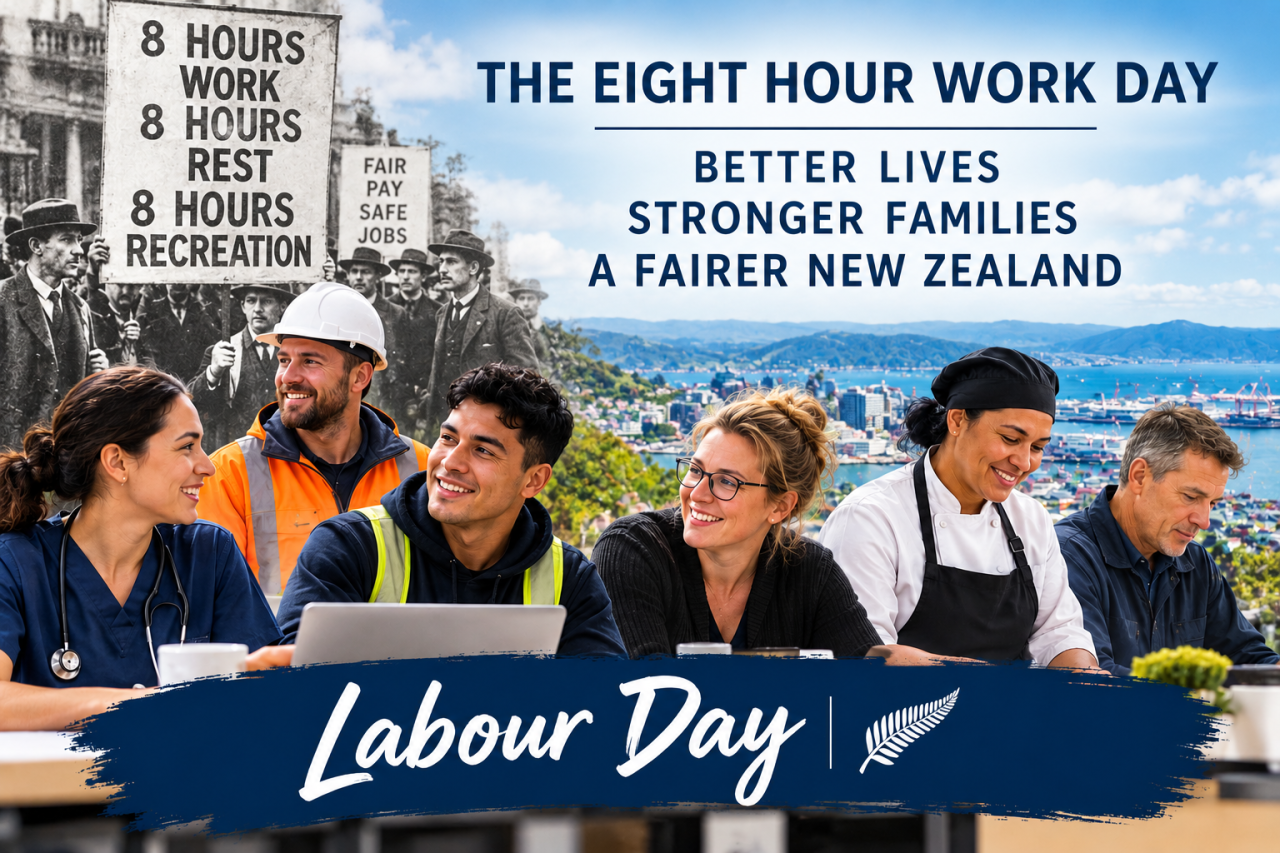
Celebrating: eight hours for work, eight hours for recreation, and eight hours for rest.
Every year, New Zealanders enjoy Labour Day as a welcome long weekend. For many, it marks the unofficial start of summer, a chance to spend time with family, tackle projects around the home, or simply enjoy a well-earned break.
Yet Labour Day was never intended to be simply a day off work. It commemorates a defining moment in New Zealand's employment history and the ongoing pursuit of fair and balanced working conditions.
The origins of Labour Day can be traced back to Samuel Parnell, a Wellington carpenter who arrived in New Zealand in 1840. When offered work constructing stores on the Wellington waterfront, he famously refused to work more than eight hours a day. At a time when working days of twelve to sixteen hours were common in many parts of the world, his position was revolutionary.
Parnell's vision was simple: eight hours for work, eight hours for recreation, and eight hours for rest. The idea quickly gained support among workers throughout the colony and became a powerful symbol of the belief that people should not live solely to work. Public demonstrations advocating for the eight-hour day became common, and in 1899 New Zealand formally recognised Labour Day as a national public holiday.
While workplaces today look very different from those of the nineteenth century, many of the principles that drove the labour movement remain embedded in New Zealand employment law. Legislation such as the Employment Relations Act 2000, the Holidays Act 2003, and the Health and Safety at Work Act 2015 all reflect a common theme: work should be productive and rewarding, but it must also be fair, safe, and sustainable.
In many respects, modern employment law continues the balance that Parnell sought to achieve. Employees are entitled to annual leave, sick leave, rest and meal breaks, minimum wages, and protection from unfair treatment. Employers, in turn, are expected to provide safe workplaces and act fairly and reasonably in their dealings with staff. These principles recognise that employees have lives, families, and commitments beyond the workplace.
Yet Labour Day also invites us to consider whether Parnell's aspirations remain relevant in a modern economy.
On the surface, it may appear that the battle for the eight-hour day has already been won. Most employees work significantly fewer hours than workers did during the industrial era, and workplace protections are stronger than ever. However, technology has fundamentally changed the relationship between work and personal time. Smartphones, emails, messaging platforms, and remote working arrangements mean that many employees remain connected to work long after they leave the office.
For some, the challenge is no longer the length of the working day but the disappearance of clear boundaries between work, recreation, and rest. A quick email in the evening, a phone call during a family dinner, or responding to messages while on holiday can gradually blur the distinction between working time and personal time.
Perhaps, therefore, the enduring relevance of Parnell's vision is not the precise number of hours worked each day. Rather, it is the principle that work should leave room for a meaningful life outside employment. More than 180 years later, employers and employees are still grappling with many of the same underlying questions. How much work is too much? How can businesses remain competitive while supporting employee wellbeing? What does a healthy work-life balance look like in an always-connected world?
These questions have become increasingly important as organisations focus on employee wellbeing, mental health, retention, and productivity. Research and experience consistently demonstrate that sustained overwork can lead to burnout, disengagement, absenteeism, and higher staff turnover. Creating sustainable workplaces is therefore not simply a matter of legal compliance; it is also a matter of good business practice.
Labour Day provides an opportunity not only to celebrate the achievements of New Zealand workers, but also to reflect on the future of work. While the world has changed dramatically since Samuel Parnell first challenged excessive working hours on the Wellington waterfront, the central idea behind his campaign remains surprisingly relevant. People should have time to work, time to rest, and time to enjoy life beyond their jobs.
More than a century after Labour Day became a public holiday, perhaps the question is not whether Parnell's aspiration of "eight hours labour, eight hours recreation, eight hours rest" is outdated. Rather, the question is how we adapt that aspiration to a world where work can follow us almost everywhere. The challenge for modern employers and employees is the same as it was in 1840: finding a balance that allows both businesses and people to thrive.
Thoughts from Buckettlaw; Labour Day serves as a reminder that employment law is about more than contracts, policies, and disputes. At its heart, it seeks to balance the legitimate needs of businesses with the wellbeing, dignity, and humanity of the people who work within them. As workplaces continue to evolve, maintaining that balance may be one of the most important employment law challenges of the modern era.